
BRINGING SCIENCE TO LIFE
Center offers unique learning kits for kids statewide
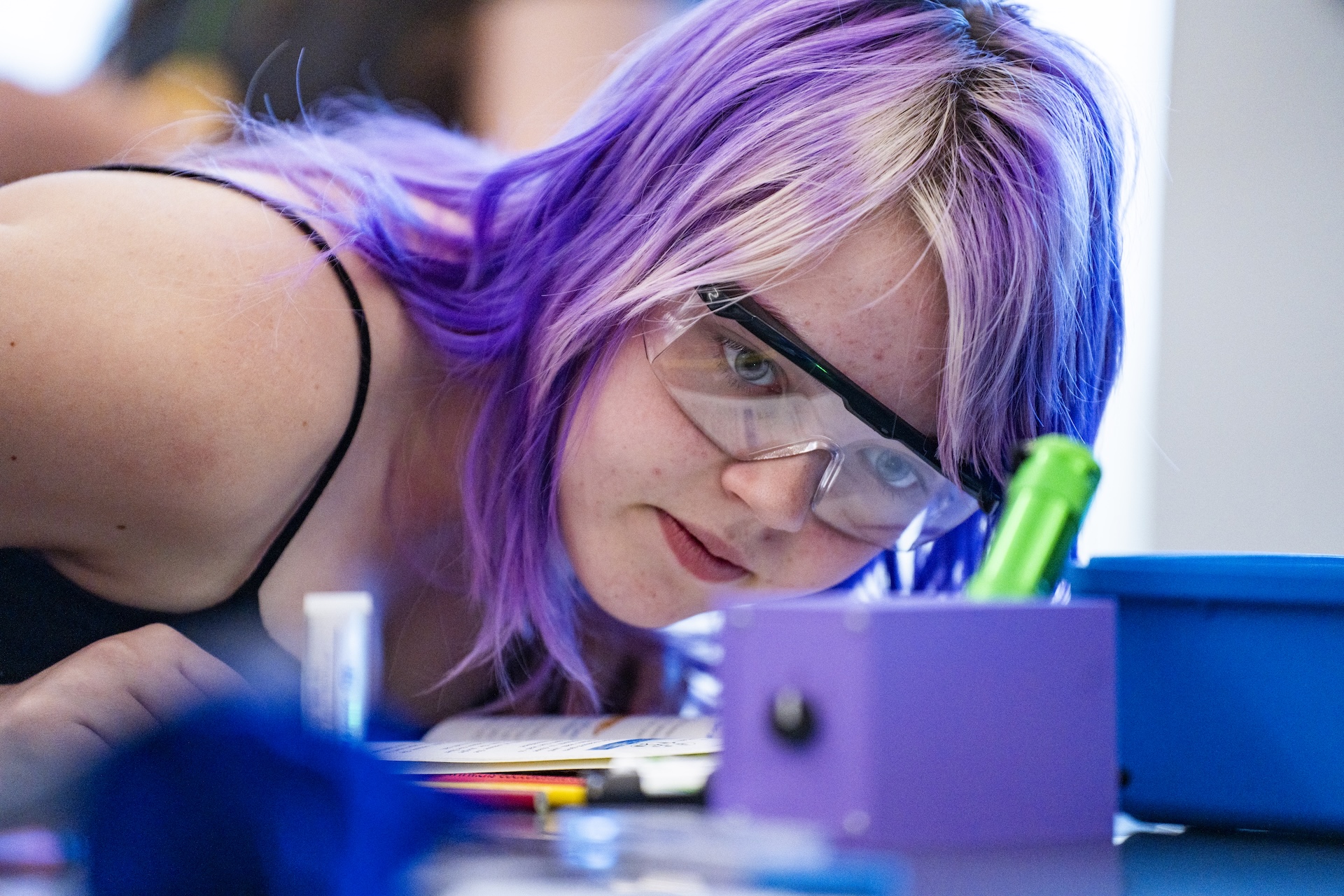
By Josh Rhoten | Photography by Kevin Samuelson / Colorado State University | Oct. 19, 2026
How does Arctic ice start to melt in the spring?
It’s a question central to understanding healthy ecosystems in the globe’s northernmost reaches – and the atmospheric chemistry that shapes our climate. As Arctic ice melts, it exposes more open ocean and absorbs more light and heat from the sun. This changes evaporation and the release of gases and tiny airborne particles called aerosols. Those aerosols, in turn, help clouds form, influencing weather and climate.
These dynamics are at the heart of research conducted by Megan Willis, a CSU chemistry professor.
Now, they’re also at the heart of a unique science education kit for high school students – called “Chasing Arctic Air” – that Willis and her team designed in collaboration with CSU’s College of Natural Sciences Education and Outreach Center.
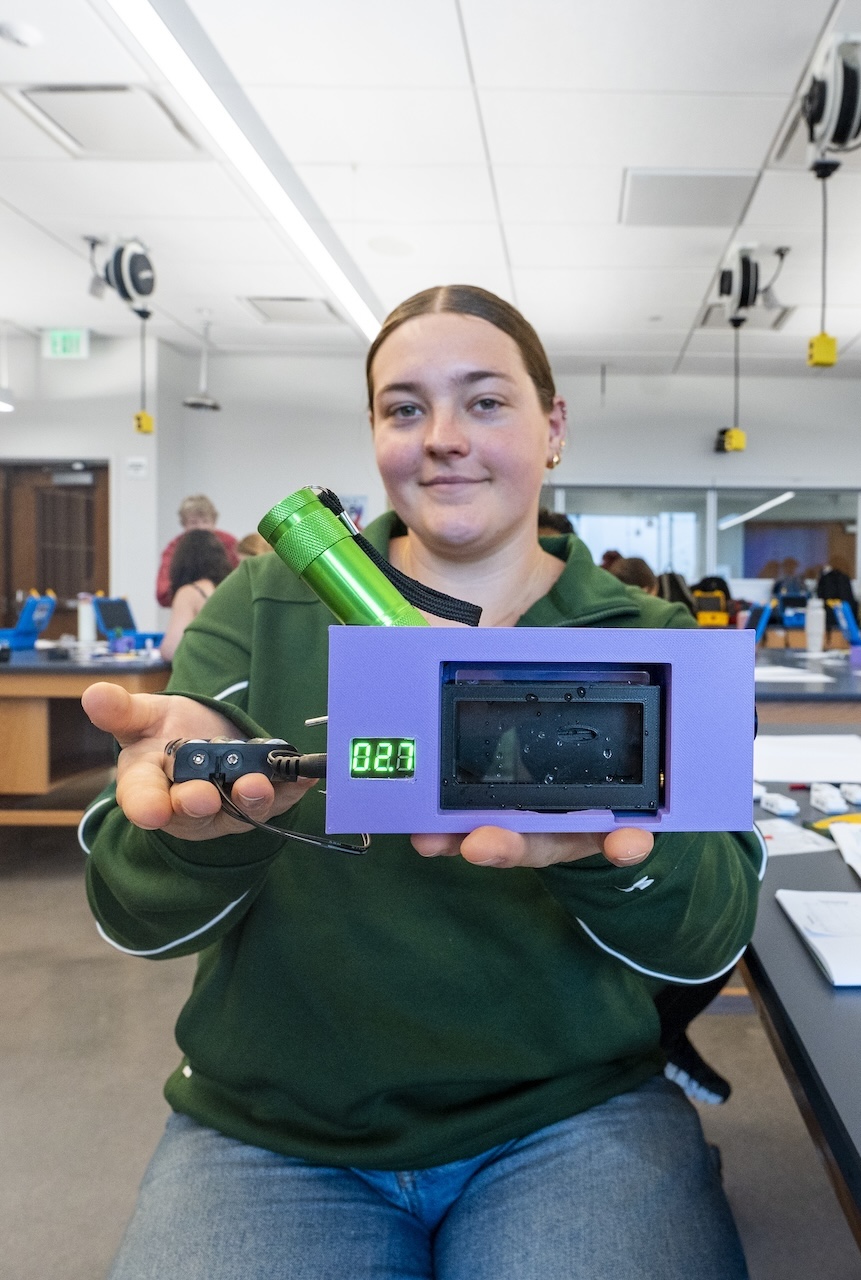
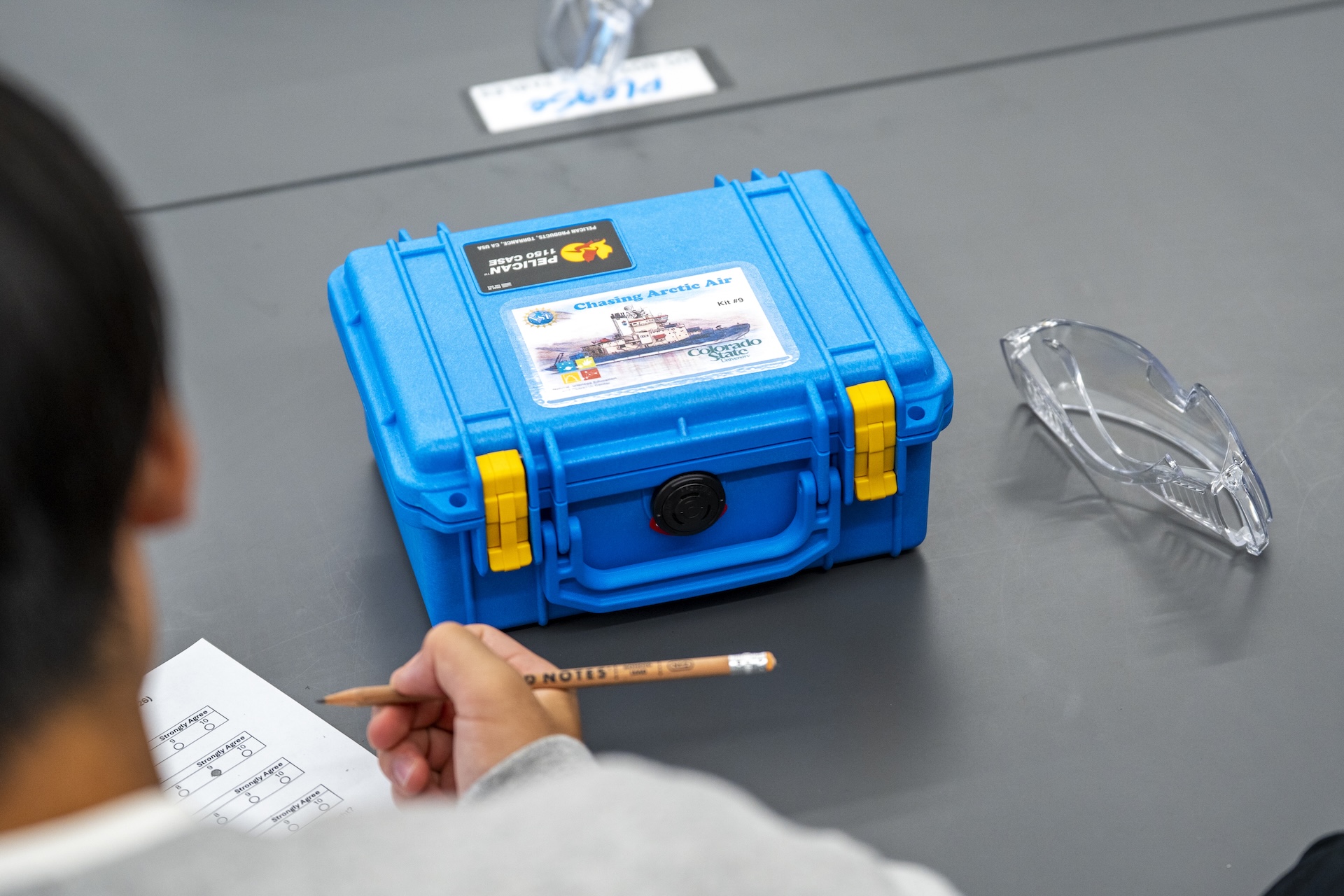
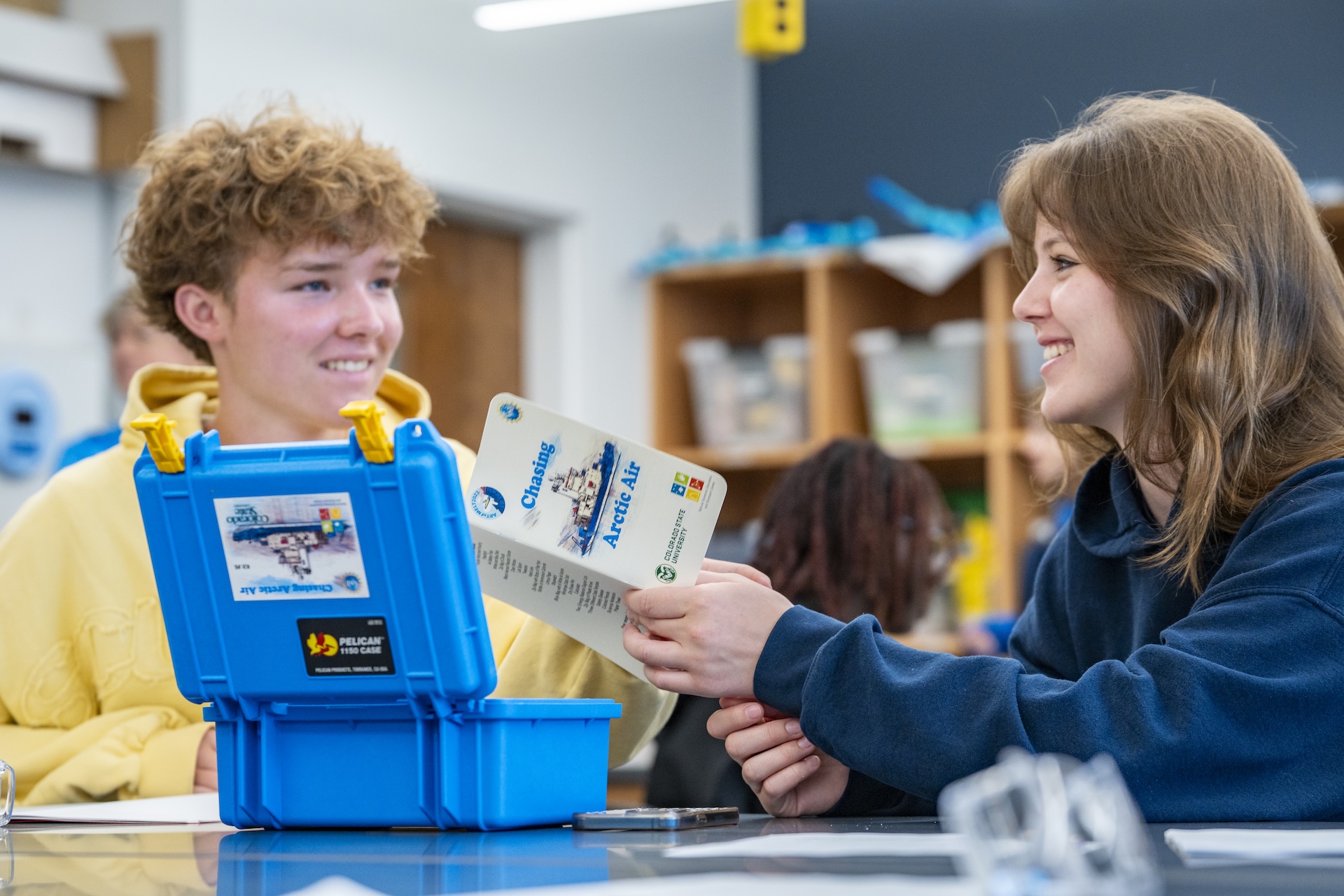
Students in the SciVet Summer Program at CSU Spur in Denver were the first to use a STEM kit called “Chasing Arctic Air,” which is designed and distributed by CSU’s Natural Sciences Education and Outreach Center.
“Chasing Arctic Air” is one of 22 STEM kits created by the center in collaboration with Colorado State University scientists. Unlike typical science learning kits, these are based on real research conducted by CSU professors. That means students using the kits explore the same evidence and grapple with the same hypotheses as professional scientists – helping the students develop identities as researchers.
What’s more, the STEM kits are available at no cost to teachers for use in classrooms across Colorado. The Natural Sciences Education and Outreach Center estimates that 7,000 students per year use the kits distributed through its STEM Kit Lending Library on the CSU campus. That makes them one-of-a-kind educational resources and one of the most important ways the university supports science literacy. The number of students reached is set to expand with new teaching sessions and outreach offered by the CSU Spur campus in Denver and by CSU Pueblo.
“These kits are world class. I had never seen anything as high quality, cohesive, and connected to research,” Willis said. “The kits engage students in the experience of being a researcher and expose them to aspects of science that go beyond the school curriculum. Most important, I believe the kits help students see the possibility that they, too, can be scientists.”

Andrew Warnock, director of the Natural Sciences Education and Outreach Center, discusses scientific concepts with students using the “Chasing Arctic Air” STEM education kit.
Kits are designed for different grade levels and meet curricular standards, so teachers may integrate them into their classrooms with ease.
And teachers have plenty of selection. Topics explored are numerous and varied: paleontology, wolf pack dynamics, groundwater salinity, the effects of wildfire on soil, viral outbreaks, trait inheritance, the path of water from forest to faucet, the glacial record, and hominid skulls, among others. Many of the offerings are for use in the classroom, while some are designed for use on field excursions. Some are also available with instruction booklets written in Spanish.
“Chasing Arctic Air” is based in part on data gathered during an international expedition on the Swedish icebreaker Oden that traveled to the Arctic Ocean – a backstory that helps students imagine scientific adventures tied to atmospheric chemistry, arctic cloud formation, and global climate change.
The real science reflected in “Chasing Arctic Air” appealed to a group of students who used the kit for the first time during the SciVet Summer Program at the CSU Spur campus in Denver last summer. “I liked that it is real,” said Linnea Wykoff, a high school senior in Boulder, who worked on the lesson for two hours with a study partner from California. “It is describing something you can actually do and be involved in. It’s not just a story in a textbook.”
Rae Pooley, a CSU doctoral candidate on Willis’ team, led development of the kit. She introduced the SciVet lesson, which included miniaturized research instruments, chemicals, lab utensils, and an illustrated instruction booklet. The last pages of each booklet describe a graduate student’s path to science, which helps young students see themselves as scientists. Some of the materials were created with a 3D printer to mimic equipment used in real-world research.
“Teachers tell us they love those sessions. They call it their ‘church’ because it re-energizes them and reminds them why they love teaching science.”
— Andrew Warnock, director of CSU’s Natural Sciences Education and Outreach Center
As students got to work, their classroom at CSU Spur buzzed with activity, and Pooley floated among students to cheerfully answer questions – offering, for instance, the definition of an aerosol.
It was one of the first times Pooley had observed students using the kit she helped develop. “The most challenging part has been trying to tell a story that is satisfying to our students while also breaking the high-level, big-picture science into small bits,” she said, adding that feedback from the lesson would help refine the kit.
The STEM Kit Lending Library, which started in 2010, is among several ongoing programs run by the Natural Sciences Education and Outreach Center and uniquely reflects its mission: supporting science educators while helping university faculty share the societal benefits of their work, especially with K-12 students. The kits also demonstrate an aspect of CSU’s land-grant mission – outreach that translates university science into real-world benefit for communities statewide.
Andrew Warnock, center director, said the kits help educate tomorrow’s STEM workforce with the latest scientific discoveries. “They offer an interactive experience that goes through the entire research process from start to finish in an engaging way students really respond to,” he said, noting they are especially useful for teachers because no additional materials are needed to lead the science lessons.

Rae Pooley, a CSU doctoral candidate, works with students using the kit, which is based on real research into atmospheric chemistry.
Funding for kit development comes from research grants awarded to CSU investigators, often from the National Science Foundation. For instance, Willis received NSF funding for her Arctic atmospheric chemistry research, and it included support for an educational project. It was a requirement she was eager to fulfill. “I’ve always been passionate about science education and supporting the development of students’ science identities,” Willis said.
She learned from colleagues about the College of Natural Sciences Education and Outreach Center, and the STEM kit program was a perfect and inspiring fit.
Kit development often takes about a year; early versions are tested by current science teachers as well as CSU students working on education degrees in science and mathematics. Stress testing can also occur as part of professional development workshops for teachers, during which they hear presentations from the CSU researchers involved, said Courtney Gooding, assistant director of the center.
“Teachers tell us they love those sessions. They call it their ‘church’ because it re-energizes them and reminds them why they love teaching science,” Warnock said. “That is some of the highest praise we can receive, and it means a lot coming from a group that is doing this vital work every single day.”
Other Center programs
In addition to the STEM Kit Lending Library, CSU’s Natural Sciences Education and Outreach Center hosts several other programs to support scientific literacy. They include:
- STEM Fridays: Teachers may visit the center’s learning studio with classes of up to 30 students for facilitated learning with STEM kits. For grades 4-12.
- SciVet Summer Program: A camp for junior and senior high school students on the CSU campus. Participants explore scientific and veterinary practices, carrying out investigations using real tools and collecting data in the lab and field.
- Colorado Science and Engineering Fair: The springtime event, hosted at CSU, is the culmination of 13 regional science fairs that feed into the state competition. Top projects advance to international competition.
- Professional development workshops: Participants include CSU and K-12 faculty, students planning to become teachers, and informal educators.
Find complete information at cns-eoc.colostate.edu.
SHARE