
HIGH ENERGY
Meet an alumnus who has served as a district attorney, Colorado governor, and national clean energy leader
By Coleman Cornelius | Oct. 19, 2026
When Bill Ritter graduated from Colorado State University with a degree in political science, his mom and 11 siblings chipped in to buy him a $99 reversible suit. It was blue on one side and blue-checked on the other – multiple options for wear. On a summer day in 1979, between his first and second years of law school, Ritter chose the blue-on-blue combination to interview for an internship at a law firm in downtown Denver.
But Ritter was working a construction job at the time, laying a water pipeline along Hampden Avenue in south Denver. So, he took the suit to work.
“I went into a porta-potty on site and changed out of my work clothes into the suit,” Ritter recently recalled. “Then I came downtown, interviewed for this internship, went back, changed out of my suit, got back into my work clothes, and went back down in the ditch.”
Ritter got the internship. It was the start of his decades-long career in law and public service – a career that included 12 years as district attorney for Denver, a term as Colorado governor from 2007 to 2011, and a role as founding director of CSU’s Center for the New Energy Economy for 14 years.
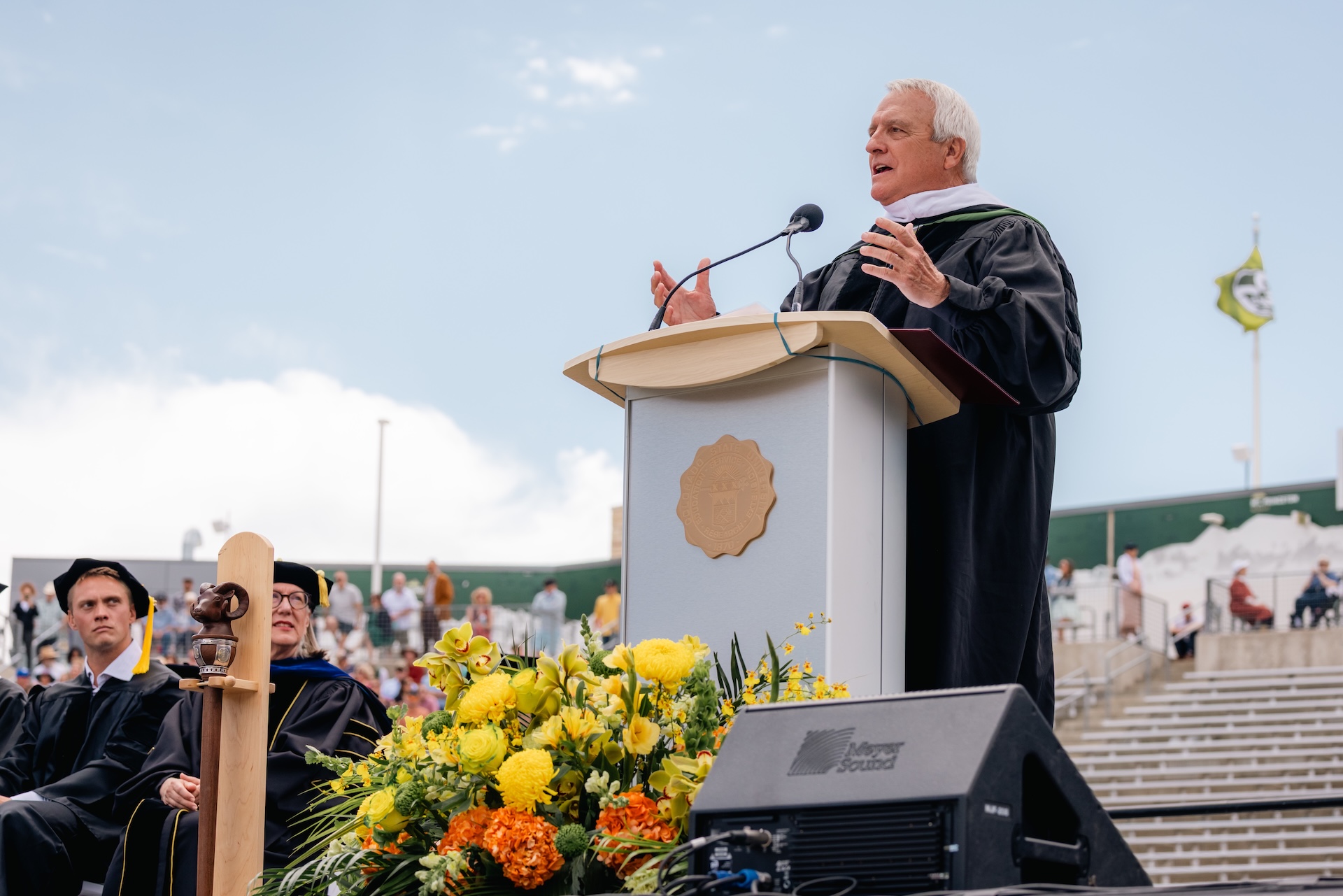
For his service and success, Ritter accepted an honorary doctorate from CSU during commencement last spring. The honor recognizes people whose achievements exemplify the university’s mission and values.
“A proud CSU alumnus, Gov. Ritter has lived out the land-grant university mission. He shares our deep belief that education, public service, and civic responsibility are essential to a thriving democracy,” CSU President Amy Parsons said while conferring the honor. “Throughout his career, Gov. Ritter has exhibited his belief that democracy depends on informed citizens, ethical leadership, and institutions willing to serve the public good.”
He embodies the land-grant mission in another way: Ritter earned his bachelor’s degree in political science from CSU in 1978 and was a first-generation student, in the first generation of his family to earn a college degree. Land-grant universities, including CSU, were founded to offer excellent higher education to anyone with the talent and tenacity to earn a degree, regardless of educational lineage.
Ritter, 70, had talent and tenacity from the start. He and his many brothers and sisters grew up on a small farm outside Aurora. They had chickens, pigs, horses – and Ritter helped milk cows twice a day. The family also farmed 1,000 leased acres of dryland wheat and feed crops for their livestock. The older boys ran the tractor and combine, and Ritter drove a grain truck not long after he could reach the pedals. For many years, their mom was a single parent.
Although he did not have family role models in the professional world, Ritter started thinking about college even as he attended Catholic schools and earned money with construction jobs. He was a high-achieving student and was successful on high school debate teams, which kindled his interest in law school.
“I’ve been just very, very fortunate to be in circumstances that allowed me to have a rich life,” Ritter said. “I was one of 12 kids raised on a farm, on a dirt road, with fairly meager circumstances. No one visiting us would have ever looked at our family and said, ‘One of these kids is going to be governor.’ It would not have entered your mind. And that’s what I mean by being rich, that I’ve had experiences that are beyond people’s imaginations – beyond my own imagination even.”
He entered public service during his second internship while attending the University of Colorado Law School, this time with the Denver District Attorney’s Office. Just out of law school, he started working in the office as a deputy district attorney and later married his wife, Jeannie.
In 1986, their lives took an unexpected turn. The couple and their baby boy followed the Catholic priest who had married them to Africa, where they served as missionaries running a nutrition center in western Zambia. There, they distributed food to impoverished and malnourished families; Ritter expanded the center to provide people with chicken and fish. As the AIDS crisis grew, the couple added AIDS education to their responsibilities.
“The people there had a very difficult existence by American standards, yet they were full of grace and hope in spite of these dire circumstances,” Ritter said. “That gave me a sense of the resilience of the human condition. It also helped me later on, when I was in public life and I faced issues. People would say, ‘We have a crisis.’ But if you’ve lived for three years in a place that’s that impoverished and see people die of AIDS and bury people who died of AIDS, you know what a crisis is. We didn’t have crises here. We had issues.”
After the family returned, Ritter rejoined the Denver District Attorney’s Office and in 1993 was appointed district attorney by Gov. Roy Romer – who also had grown up on a Colorado farm, graduated from CSU, and attended CU Law School. As district attorney, Ritter established one of the nation’s first drug courts, strengthened victim-services programs, and led efforts to hold both violent and white-collar criminals accountable.
“I cannot tell you how much I loved the work of being the district attorney of Denver,” Ritter said. But after 12 years in the job, he was term limited – “I had a sell-by date,” he said with a laugh – and soon looked at the possibility of running for governor of Colorado, having often been part of the legislative process as district attorney. He spent a year traveling around the state for on-the-ground learning about education, healthcare, transportation, energy, the environment, and other concerns. He ran and was elected governor in 2006.
Building a new energy economy focused on renewable energy became a pillar of Ritter’s term in office. Witnessing public support for solar and wind energy, he saw it as a route to jobs, economic development, environmental health, and improved human health.
“Justice has been a through line in my career, and with the new energy economy, I really saw a way to bring communities along when they had been left behind by the fossil fuel economy,” he said. “I don’t disparage coal. I don’t disparage natural gas. It’s the emissions that are problematic. We built a lot in this country and in this state because of coal. We built a lot in this country and in this state because of natural gas. But I had a vision for a different kind of future, one that could bring communities along differently.”
“Every success I’ve had in my life, I draw a straight line back to CSU because it was such a great foundation for learning how to learn – and I’ve had to learn a lot.”
— Bill Ritter, CSU alumnus and 41st governor of Colorado
Ritter opted not to run for a second term as Colorado governor, and CSU System Chancellor Tony Frank, who was then president of Colorado State University, jumped at the chance to hire Ritter as founding director of a new university think tank called the Center for the New Energy Economy.
“When he chose not to run for a second term as governor in 2010, it struck me as a rare opportunity for CSU. We had the chance to bring a former governor onto our team to lead policy discussions around an issue where he was a nationally respected leader and, simultaneously, where CSU was one of the world’s true research leaders – clean and renewable energy,” Frank said. “Over 14 years, with the Center for the New Energy Economy that he designed and built, he brought respectful, candid, and strategic leadership to a national conversation that has benefited greatly from his engagement. It’s been wonderful for our students, our faculty, and the state.”
During his time with the center, Ritter advised President Barack Obama on issues related to renewable energy. He authored a 2014 report for the Obama administration titled Powering Forward: Presidential and Executive Agency Actions to Drive Clean Energy in America, which offers 200 recommendations for a transition to a clean energy economy. Two years later, he also published a book titled Powering Forward. The center at CSU launched a clean energy academy for legislators and a database tracking state legislation; it also conducts gap analyses of state clean energy legislation.
Despite the accelerating pace of climate change, Ritter remains hopeful about the potential for clean energy. In many places nationwide, it has public support, corporate support, and the support of utilities, he said. “If you have state policies supporting the energy transition and corporate decisions supporting the energy transition, there will be economic decision-making that’s rational and positive,” he said. “It happens over decades. That’s why I still have a very positive feeling about it.”
Last year, Ritter retired from the Center for the New Energy Economy. As he reflected on his career, he said, “Every success I’ve had in my life, I draw a straight line back to CSU because it was such a great foundation for learning how to learn – and I’ve had to learn a lot.”
He nearly went to the University of Notre Dame, having earned a scholarship to attend. But his mom insisted that Ritter go to CSU – the state ag school. Years later, he had a good laugh about it.
“When I became governor, the night of the inauguration, we had a party at the governor’s mansion with all my family,” Ritter said. “My mom came, and she goes, ‘I knew that CSU thing was going to work out for you.’”
Photo at top: Former Colorado Gov. Bill Ritter received an honorary doctorate from CSU during commencement last spring. He graduated from CSU in 1978 with a bachelor’s degree in political science and attended the University of Colorado Law School before becoming district attorney for Denver and 41st governor of Colorado. Two of his four children also attended CSU. Photo: John Cline / Colorado State University Photography.
SHARE